
Picture a middle school hallway between classes. Someone says something cruel, loud enough for a few kids to hear. There's a laugh from somewhere. The student it was aimed at freezes, or snaps back, or goes quiet and keeps walking.
What happens next usually takes about ten seconds. It's also where most of what we call character education either shows up or doesn't.
October is National Bullying Prevention Month, and schools will mark it in plenty of good ways: assemblies, orange shirts, pledges, posters. Don't get me wrong, those matter. They tell students what the school stands for. But the moments that shape a kid's sense of safety are rarely the scheduled ones. They're the ten seconds after something goes wrong, when nobody has time to look up a policy.
So it's worth asking: what are we actually preparing students and adults to do in those ten seconds?
Three people, one moment
Every hard moment in a hallway has at least three people in it.
- The student it happened to. In the first few seconds, their body is doing what bodies do under threat: their heart rate climbs and their attention narrows to the fight-or-escape options. In GRiT we call this the brain's smoke alarm going off. It's useful when there's a real fire. It's less useful when the "fire" is a comment from a classmate, because a student who is flooded has very few choices available to them in that moment.
- The student who saw it. Bystanders hold a lot of power, and most of them know it. What they usually lack is a move. Saying "stop" in front of a crowd is hard for adults, let alone thirteen-year-olds. Walking over and standing next to the student who got targeted, or saying "come on, let's go," is smaller and far more doable. But only if it has been practiced somewhere before.
- The adult who walks up. Adults arrive mid-story, usually to the loudest part of it. If the target snapped back, that may be the only thing the adult sees. How the adult shows up in those first few seconds, calm or charged, curious or certain, tells every student watching what this building does with conflict.
None of those three can think their way through the moment from scratch. They'll do what they've practiced.
Character is a set of skills
We tend to talk about character as something kids have or don't have. Respectful, kind, honest. Those words are real, but they describe outcomes. The skills underneath them are more practical, and they can be taught.
One tool GRiT students learn early is a simple equation: E + R = O. The event plus your response equals the outcome. Students can't control what someone says in the hallway. They can learn to notice what their body is doing, slow down long enough to choose a response, and see how different responses lead to different outcomes. That sounds simple on paper. In a classroom, it takes reps.
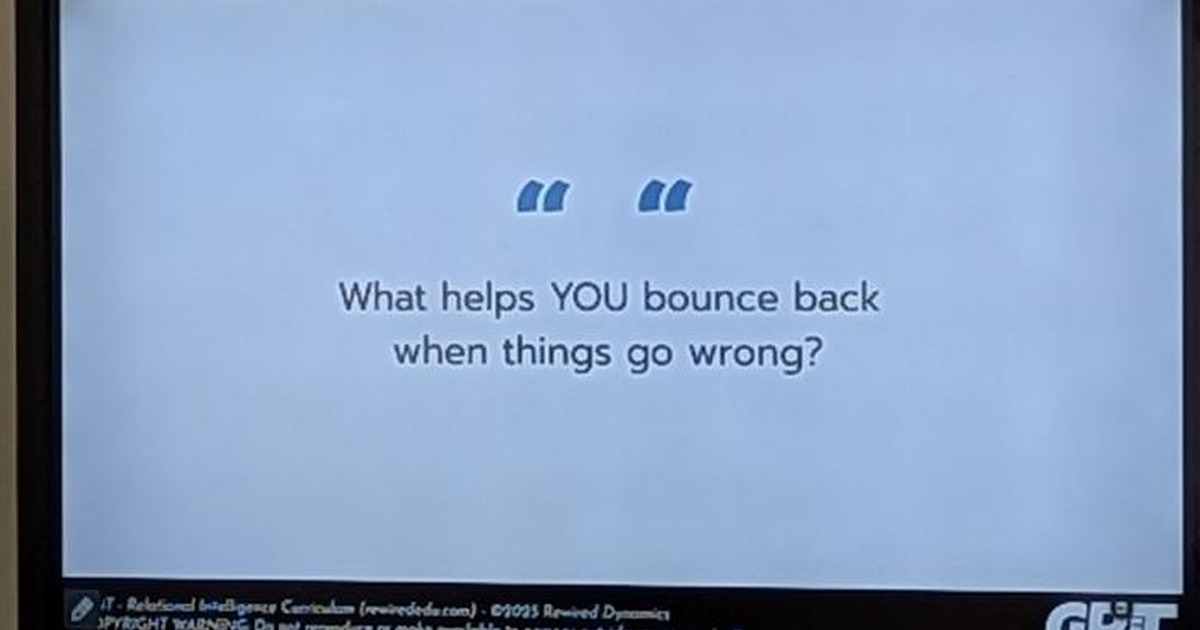
That's why a GRiT lesson might open with a question like the one in this post's photo: "What helps YOU bounce back when things go wrong?" Students answer it on an ordinary day, with nothing on the line, so the answer is already within reach on a hard one.
The same logic applies to bystanders. A class can practice the small moves (walking over, changing the subject, checking in afterward) the same way they'd practice anything else, by naming it, trying it and talking about how it felt.
The adults go first
Students learn regulation from watching adults regulate. A teacher who can take a breath before responding to a heated moment is teaching something no slide can.
This is the hardest part of character education, and the most overlooked. Adults are asked to manage behavior all day while carrying their own stress. When we train educators in GRiT, a big piece of it is helping adults understand their own stress response first. It's hard to coach a student through a moment you can't get through yourself.
What the law asks, and what students need
There are seventeen states require character education by law, and another 27 who recommend it or publish standards for it. (We mapped every state at rewirededu.com/character-education-by-state.) Requirements like these are a good thing. They signal that how students treat each other belongs in the school day, not just on the discipline referral form.
A requirement can be met with a binder, though. The question worth asking of any program, ours included, is whether it changes what students and adults actually do in the ten seconds after a hard moment. That's the standard students experience, whatever the statute says.
Where to start this month
You don't need a new curriculum to start working on this. A few places to begin:
- Ask your staff what usually happens in the first few seconds after a conflict in your building, and what they wish happened instead.
- Pick one bystander move and practice it with students this month. Keep it small enough that a nervous seventh grader could actually do it.
- Before the next hard moment, give adults one shared phrase for walking up to a conflict calmly, so students hear the same thing from every adult.
Bullying Prevention Month ends on October 31. The hallway moments won't. The schools that make real progress are the ones that treat those ten seconds as something worth practicing all year.
If you're in Fond du Lac County, we're hosting a free lunch-and-learn on exactly this skill, staying regulated under pressure, on November 12. Details are on our events page at rewirededu.com/events.
Want this in your school?
See how GRiT and Compass work together, in real time.
→ Book a discovery call