
Courage Is a Skill Students Can Practice
In one GRiT activity, a student puts on a blindfold and walks across a gym floor scattered with cones, balls and pool noodles. The only guide is a classmate's voice. Everyone else watches.
That walk across the gym is a good picture of how courage works in a school. It shows up in small, specific moments, and it gets stronger the more often students practice it.
A trait, or a skill?
We tend to talk about courage as something a student has or doesn't have. One kid is brave, another is shy. That framing quietly lets everyone off the hook. If courage is a trait, there isn't much a school can do about it.
GRiT treats courage as a skill. It's the third of the five dynamics in our curriculum, and we define it in four words: name it, do it anyway. Both halves matter. Naming means a student can say what is hard right now: the presentation, the apology, the friend who isn't being a friend. Doing it anyway means taking the next step while the hard thing is still hard.
Skills can be taught, practiced and measured. That changes what a school can do.
Why practice matters
Our own Kurt Wismer wrote about this for Getting Smart in July 2025. His point was that schools, while trying to protect students from discomfort, sometimes "shield them from the very conditions that build strength." Challenge that sits just past a student's comfort zone, what Vygotsky called the zone of proximal development, is where growth happens.
That doesn't mean throwing students into the deep end. It means designing challenges on purpose, with support close by, and then helping students talk about what happened. The challenge gives them a rep. The conversation afterward is where they learn to name it.
Three kinds of reps schools can build
When we look at the activities that do the most for courage in GRiT classrooms, they tend to fall into three groups.
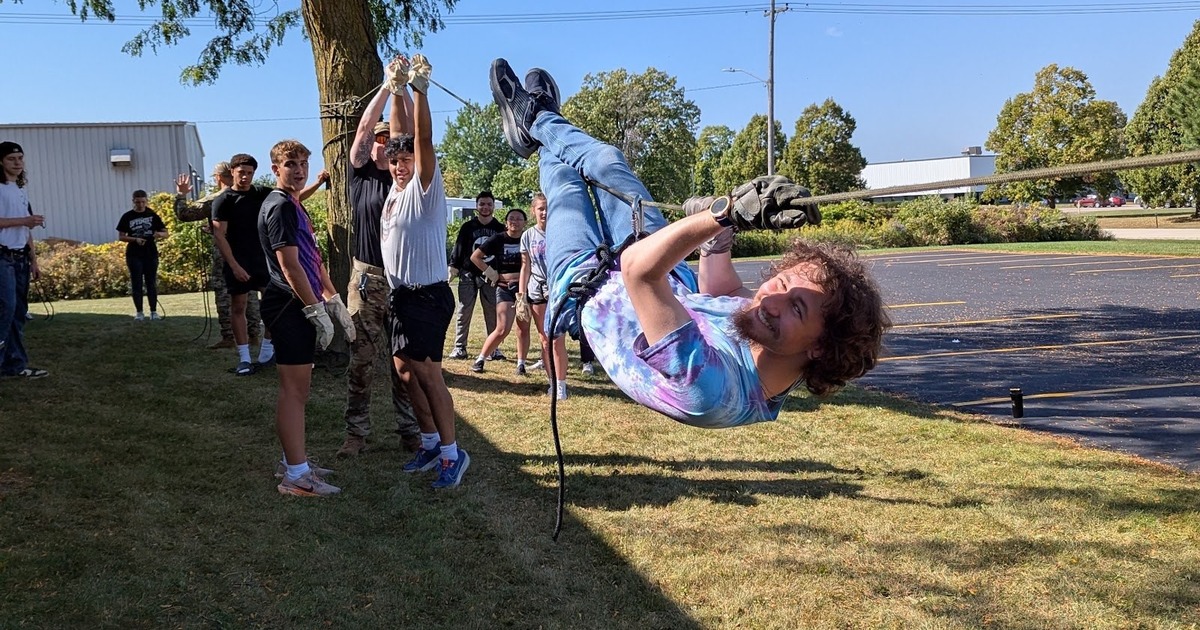
Physical challenge. On October 23, students in a GRiT class at Horace Mann High School in North Fond du Lac took on the Mt. Everest Challenge with the Fond du Lac Wisconsin National Guard. They lined up at sunrise, worked through deadlifts, balance boards, cone relays and team drills, and shared MREs. At an earlier GRiT challenge day with the Guard, students took turns crossing a rope strung from a tree while their classmates watched. Physical challenge is honest. Your body tells you it's hard, and you decide what to do next with people watching.
Trust under uncertainty. The blindfold course is one example. A student has to act without full information and rely on someone else. That's the same muscle a student uses when they raise a hand without being sure of the answer, or tell an adult what's really going on.
Failing in front of others. Give a group of students dry spaghetti, tape and marshmallows and ask for the tallest tower. Towers lean. Some fall. The group has to decide whether to start over, and someone has to say "I think my idea was the problem." That sentence takes courage, and students who practice it in a low-stakes activity have an easier time saying it when the stakes are real.
After each of these, the important part is the debrief. What was the hard moment? What did you tell yourself? What did you do next? Those questions turn an activity into a skill students can name and use again.
Adults go first
Students learn courage by watching the adults in the building. They notice when a teacher says, "That lesson didn't work, let's try it another way." They notice when a principal asks a question at a staff meeting without knowing the answer. They notice when an adult comes back after a hard moment to repair it.
This is one reason educator training and certification are part of every GRiT program. When staff and students share the same language for courage, a teacher can say "name it" in the hallway and a student knows exactly what that means.
Seeing courage grow during the year
If courage is a skill, schools should be able to see it change. Most SEL measurement arrives in a report after the year is over, which is too late to help the students in front of you.
GRiT Compass takes a different approach. Quick student check-ins are built into GRiT lessons, with no extra testing window. Each response updates a whole-school view of all five dynamics, including Courage, in real time. If courage is climbing in seventh grade and flat in eighth, a counselor or principal can see that this month and adjust: a small group, a different activity, a conversation with a team of teachers. (You can see a sample dashboard at rewirededu.com/compass. The data there is illustrative.)
The Courage Within
This year's Wisconsin School Counselor Association conference theme is "The Courage Within." School counselors work on this every day, in the moments when a student decides whether to say what's really going on.
We'll be at WSCA in Wisconsin Dells on November 4 and 5 as a vendor. If you're a counselor, stop by and tell us where you see students needing courage most. We'd like to hear it.
Where to start
You don't need a new program to start building courage this week. Pick one activity with a real chance of failure. Do it with support close by. Then ask the three debrief questions and let students answer out loud.
If you're planning SEL for the 2027-28 school year and want courage built into the whole school, with a way to see it grow, we'd be glad to show you how GRiT and Compass work. Book a discovery call.
Want this in your school?
See how GRiT and Compass work together, in real time.
→ Book a discovery call